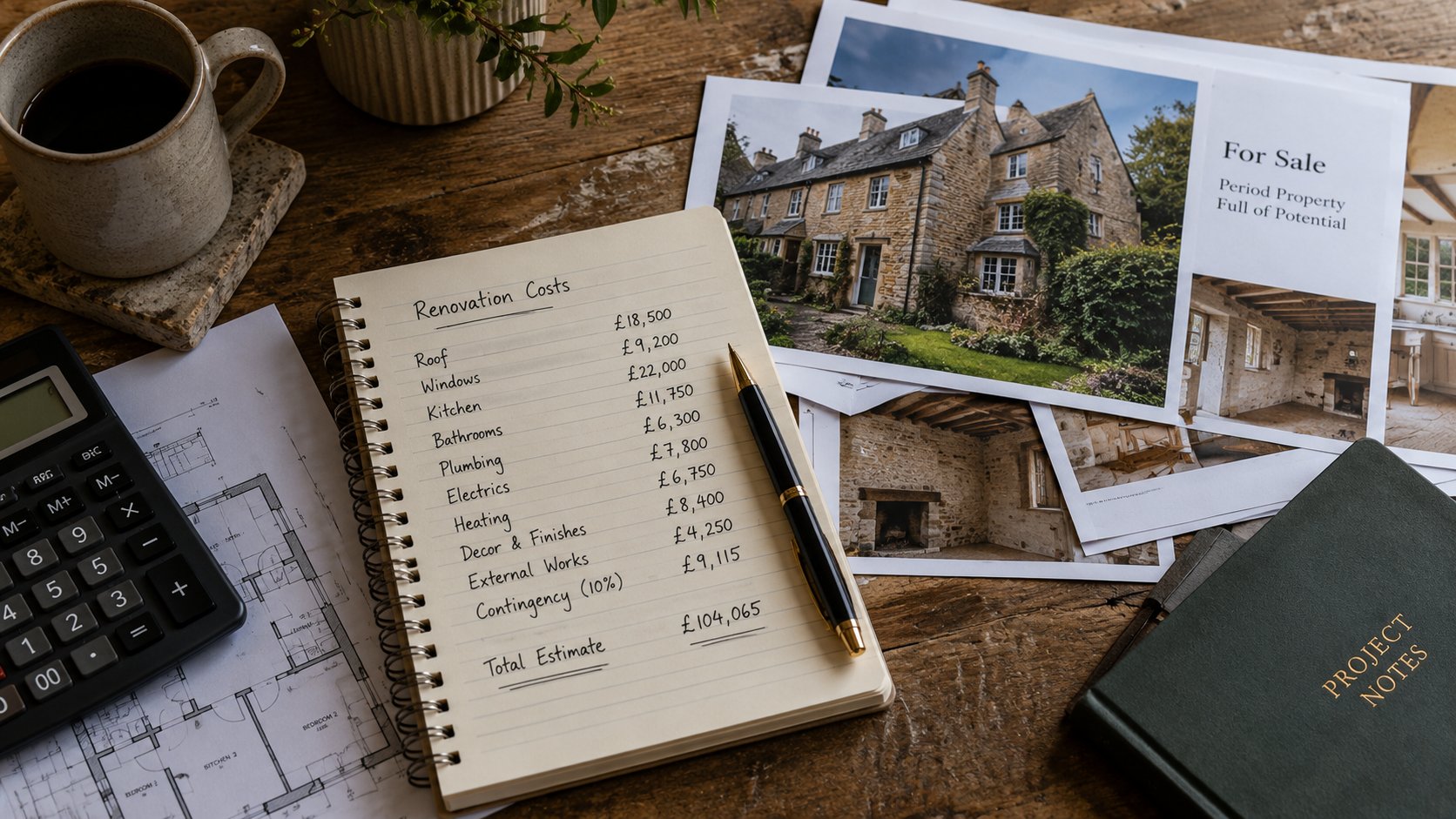

How do you budget for a renovation before making an offer? The answer involves a systematic approach to cost assessment that most buyers either skip or get wrong — and that gap is where renovation property purchases most commonly fail.
Step 1 — What renovation scope does the property actually need?
Before any numbers are meaningful, you need to understand what the property requires. This goes beyond a viewing — it requires someone with construction experience walking the building and assessing every element systematically: structure, electrics, plumbing and heating, damp, windows and doors, kitchen and bathrooms, internal finishes, and external condition.
Step 2 — How do you build a reliable renovation cost breakdown?
Once the scope is understood, each element needs a realistic cost based on current contractor pricing for the area and property type — not a rough guess. Our period property cost guide gives indicative ranges by trade. The breakdown should be room by room and trade by trade so you can understand where the money is going, identify elements you might phase or defer, and cross-reference against contractor quotes when you begin tendering.
Step 3 — What costs do renovation budgets most often miss?
Making good after trades
Every trade that opens up the building leaves reinstatement work. Rewiring requires replastering. Plumbing requires boxing in or making good. These costs are real and significant — add them explicitly, not as a lump sum at the end.
Scaffolding
Any external work above ground floor requires scaffolding. This is not included in most roofing or window quotes. A full scaffold on a 3-bed property costs £2,500–£5,000 for a standard hire period.
Waste disposal
Stripping out kitchens, bathrooms, or any significant internal demolition generates waste that costs money to remove. Skip hire and disposal labour adds £1,500–£4,000 across a full renovation project.
Professional fees
Architect drawings, structural engineer reports, planning applications, building regulation applications. Budget £3,000–£10,000+ for professional fees on any property requiring structural work or planning consent.
Finance costs
If you are borrowing to fund the renovation, the interest cost over the build period is a real project cost. On a £100,000 renovation funded by a bridging loan at 1% per month for eight months, that is £8,000 in finance costs before a single trade invoice is paid.
Step 4 — How much contingency should a renovation budget include?
On any older property, 15–20% contingency is not optional — it is the acknowledgement that older properties hide things, that scope changes when walls come down, and that costs on real projects are higher than estimates.
The total cost calculation: Purchase price + renovation costs + contingency + purchase costs (stamp duty, legal fees) + finance costs = your true project cost. That total, compared to the post-renovation value of the property, tells you whether the deal makes sense before you commit to it.
Step 5 — How do you make an offer that reflects the renovation cost?
With a reliable renovation cost in hand, your offer calculation becomes straightforward. If comparable renovated properties sell at £350,000 and your renovation will cost £80,000 plus a 20% contingency (£96,000), plus £15,000 in purchase costs, you can work backwards to a maximum purchase price that makes the project viable. This is offer-making based on numbers — not hope.
Every renovation job, every range — and why the cheapest quote is usually the most expensive.
Build your renovation budget before you offer.
NOROS Assessments provides the room-by-room cost breakdown you need to budget properly before making an offer. Delivered within 48 hours. From £99 for a desktop review, £250 for a full site visit assessment.
Get in Touch