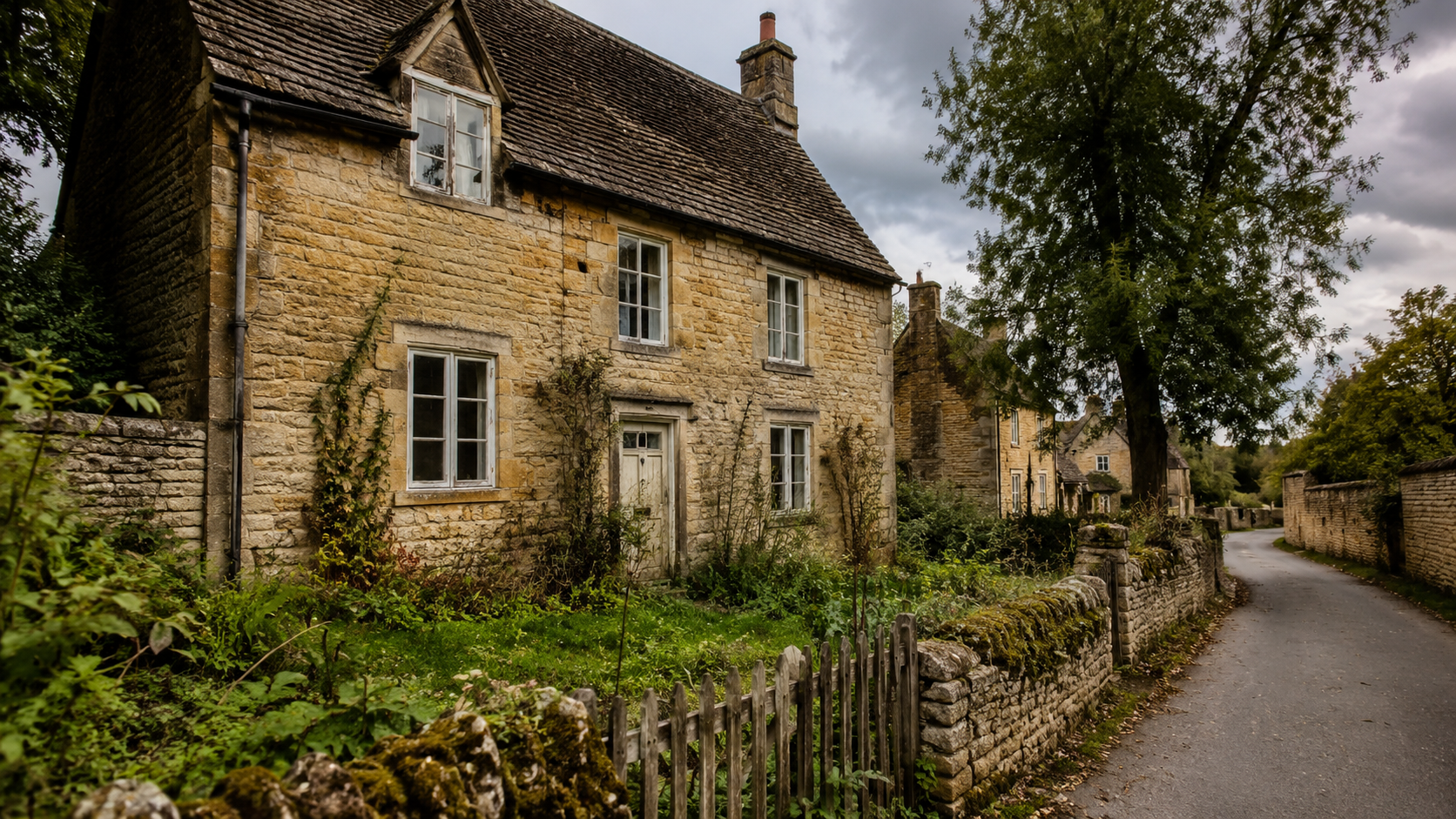

The Cotswolds property market is unlike anywhere else in England. Properties command significant premiums — a cottage in Bourton-on-the-Water, Burford or Chipping Campden can cost two or three times what a comparable property would fetch twenty miles away. And renovation costs follow the same pattern. Working on Cotswolds properties costs more than national averages, for reasons that are structural and unavoidable — not simply a matter of contractors charging what they can get away with.
This guide is written from direct construction experience in the Cotswolds and surrounding counties — Gloucestershire, Oxfordshire, Wiltshire and Warwickshire. The figures here reflect what projects actually cost in this region in 2026, not what a national calculator tells you they should.
How much more expensive is renovation in the Cotswolds than the national average?
As a baseline: renovation costs in the Cotswolds run 15–25% above national UK averages for comparable work on comparable properties. On a listed building, the premium rises to 30–45% above national averages. This isn't arbitrary — it reflects three compounding factors:
- Skilled trade scarcity. Cotswold limestone is a specialist material. It requires hydraulic lime mortars rather than cement, sympathetic working methods, and an eye for matching stone colour and coursing. Tradespeople who can do this properly — stonemasons, lime plasterers, heritage joiners — are in short supply across the entire region. They charge accordingly.
- Listed building and conservation area requirements. An estimated 5,900 listed buildings sit within the Cotswolds AONB alone. Listed Building Consent requires approved materials and methods — which typically means more expensive options. You cannot substitute a cheaper modern product for a traditional one without consent.
- Logistics and access. Many Cotswolds villages have narrow lanes, no parking, restricted delivery access, and no local trade supply yards. Materials take longer to get in. Skips take longer to get out. Labour time costs money.
What does renovation cost in the Cotswolds — by scope?
| Renovation Scope | Cotswolds Cost Range (2026) | National Equivalent |
|---|---|---|
| Cosmetic refresh | £18,000–£42,000 | £15,000–£35,000 |
| Light renovation | £45,000–£90,000 | £35,000–£75,000 |
| Full renovation | £90,000–£160,000 | £75,000–£140,000 |
| Full renovation — listed building | £130,000–£250,000+ | N/A — listed premium applies |
| Extension (single-storey rear) | £55,000–£110,000 | £40,000–£90,000 |
The listed building trap: buyers frequently underestimate the cost uplift on listed Cotswolds properties. The listing isn't just an extra planning step — it affects every single material and method used on the project. A bathroom refit that costs £7,000 on an unlisted property can cost £14,000 on a listed one, purely because of the constraints on how work can be done and finished.
The Cotswolds stone premium — what does stone work actually cost?
Cotswold limestone is the defining material of the region. It is also one of the most expensive building materials to work with correctly. Whether you're repointing, replacing damaged stone, or matching new work to existing, the costs are significantly higher than brickwork equivalents.
Repointing
Cotswold stone walls must be repointed with hydraulic lime mortar — not sand and cement. Cement is incompatible with limestone: it traps moisture, causes spalling, and damages the stone face over time. The right mortar is slower to mix, harder to work with, and more expensive. Repointing Cotswold limestone costs £60–£120 per square metre, against £30–£60 per square metre for standard brickwork. A full external repoint on a typical Cotswolds cottage runs £10,000–£25,000.
Stone replacement
Where stone has spalled, cracked or is missing, replacement must match the existing in colour, texture and coursing. Matching Cotswold limestone sourced locally costs significantly more than standard building stone. Replacement stone costs £150–£400 per stone depending on size. A stonemason working on a Cotswolds wall charges £350–£550 per day, against £200–£350 for general brickwork.
Dry stone walling
Dry stone walls are a feature of Cotswolds properties and gardens. Rebuilding or repairing dry stone walling costs £200–£450 per linear metre for a traditional two-faced wall, including stone. A skilled dry stone waller in the Cotswolds is difficult to find at short notice — lead times of 3–6 months are not unusual.
Listed buildings in the Cotswolds — what does the premium look like in practice?
We have a full guide to renovating listed buildings in the UK. For Cotswolds buyers, the key practical implications are:
Windows
Listed buildings require timber windows matching original profiles. Secondary glazing is sometimes permitted; double-glazed timber units are the standard modern solution. A replacement timber sash window costs £1,200–£2,500 per window fitted in the Cotswolds. A whole cottage with 8–10 windows: £12,000–£25,000.
Roofing
Cotswolds properties are often roofed in Cotswold stone slate — a split limestone tile that is now extremely scarce. New stone slate is difficult to source and costs £80–£140 per square metre for materials alone. Reclaimed stone slate costs £50–£90 per square metre but requires careful grading and sorting. A full re-roof in stone slate on a three-bedroom cottage costs £35,000–£65,000 — three to four times the cost of a standard concrete tile re-roof.
Internal works on listed buildings
Even internal works require Listed Building Consent if they affect the character of the building. This includes: removing internal walls, altering staircases, changing floor finishes, inserting new openings, and removing original joinery. Lime plaster must be used on all internal walls — modern gypsum plaster is not appropriate and may not be consented. Lime plastering costs £40–£80 per square metre, against £15–£30 for modern gypsum.
Every renovation job, every range — and why the cheapest quote is usually the most expensive.
Know exactly what a Cotswolds property will cost before you offer.
NOROS Assessments specialises in pre-purchase renovation cost assessments across the Cotswolds — Gloucestershire, Oxfordshire and Wiltshire. We understand listed building constraints, local trade rates, and what Cotswold stone work actually costs. Desktop assessment from £99.
Get a Cotswolds Cost CheckRoom by room: Cotswolds renovation cost breakdown (2026)
| Element | Standard Property | Listed Building | Notes |
|---|---|---|---|
| Full rewire | £10,000–£18,000 | £14,000–£24,000 | Listed: surface-run or careful concealment required |
| New central heating | £8,000–£14,000 | £10,000–£18,000 | Listed: underfloor heating may require consent |
| Kitchen (fitted, mid-range) | £12,000–£22,000 | £15,000–£30,000 | Bespoke in keeping with character often required |
| Bathroom (full refit) | £7,000–£14,000 | £9,000–£18,000 | Floor structure may require attention in older properties |
| External repoint (whole house) | £10,000–£25,000 | £12,000–£28,000 | Hydraulic lime mortar mandatory — no cement |
| Roof (stone slate) | £35,000–£65,000 | £40,000–£75,000 | Stone slate mandatory on most listed properties |
| Windows (timber, whole house) | £14,000–£26,000 | £16,000–£32,000 | Must match original profiles; uPVC not permitted |
| Damp treatment + lime replaster | £10,000–£24,000 | £14,000–£30,000 | Lime plaster only on listed — no modern gypsum |
| Dry stone walling (per 10m) | £2,000–£4,500 | £2,500–£5,000 | Long lead times — book well in advance |
| Full internal decoration | £5,000–£10,000 | £6,000–£14,000 | Lime paint or breathable finishes on solid walls |
What are the hidden costs specific to Cotswolds properties?
Planning and consent fees
Listed Building Consent applications cost nothing to submit — but the professional fees to prepare them do. An architect or heritage consultant to prepare a Listed Building Consent application costs £1,500–£5,000 depending on complexity. If the application is contested or requires pre-application advice, add further fees. Planning applications for extensions in the AONB cost £206 to submit; professional preparation adds £1,500–£4,000 on top.
Archaeological survey requirements
In some Cotswolds locations — particularly around historic market towns like Cirencester, Stow-on-the-Wold and Chipping Norton — groundworks may trigger a requirement for archaeological monitoring or investigation. This can add £1,500–£15,000 to a project, and in rare cases can significantly delay or alter planned works. Always check with the planning authority before assuming groundworks will be straightforward.
Bat surveys
Old Cotswolds properties frequently have bat roosts — and bats are strictly protected under UK law. Before any roof or loft work, a preliminary roost assessment (PRA) is required if bats are suspected. Cost: £250–£500. If bats are confirmed, a full survey is required (£800–£2,500), and a European Protected Species licence may be needed before work can proceed — adding weeks or months to the programme.
Contractor availability and lead times
The Cotswolds has a relatively small pool of heritage-skilled tradespeople serving a very active property market. The best stonemasons, lime plasterers and heritage joiners are booked 3–9 months in advance. If you exchange on a property expecting to start work immediately, you may find your preferred contractors unavailable for six months. Factor this into your purchase decision and cashflow planning.
Is renovation in the Cotswolds worth the premium?
For the right property in the right location, yes — consistently. Cotswolds property values in prime villages have shown long-term resilience that outperforms most of the UK market. A well-renovated cottage in Bourton-on-the-Water, Burford or the Chipping Norton area typically achieves a significant end value premium over unrenovated equivalents.
But "worth it" depends entirely on the numbers stacking up — and that requires knowing the real renovation cost before you make an offer, not after you've exchanged. The gap between what buyers assume and what Cotswolds renovation actually costs is wider than anywhere else in the UK. See how buyers use renovation assessments to negotiate on price and how to work out what to offer on a property that needs work.
Frequently asked questions — Cotswolds renovation costs
Do I need an architect for a Cotswolds renovation?
Not always — but often. For a straightforward internal renovation of an unlisted property, a main contractor can manage the project without an architect. For listed building consent applications, extensions, loft conversions, or any work requiring planning permission in the AONB, an architect or heritage consultant experienced in Cotswolds work is strongly recommended. Their fees (typically 8–15% of construction cost) are offset by better outcomes and avoided mistakes.
Can I use a national contractor for a Cotswolds project?
For standard trades — electricians, plumbers, decorators — yes. For heritage stonework, lime plastering, and timber joinery on listed buildings, local specialists are strongly preferable. National contractors often underestimate the complexity of working with Cotswold limestone and lime mortar systems, leading to poor results and remedial costs.
How do I find a good stonemason in the Cotswolds?
The Cotswold Conservation Board maintains a list of approved contractors experienced in working within the AONB. The Dry Stone Walling Association of Great Britain has an accredited contractor register. Word of mouth from local estate agents and planning consultants is also reliable. Book well in advance — the best ones are always busy.
What is the Cotswolds AONB and how does it affect my renovation?
The Cotswolds Area of Outstanding Natural Beauty covers 2,038 square kilometres across Gloucestershire, Oxfordshire, Warwickshire, Worcestershire and Wiltshire. If your property is within the AONB, permitted development rights are more restricted — certain works that would not require planning permission elsewhere do require it within the AONB. Roof materials, external finishes, and the appearance of extensions are all subject to greater scrutiny.