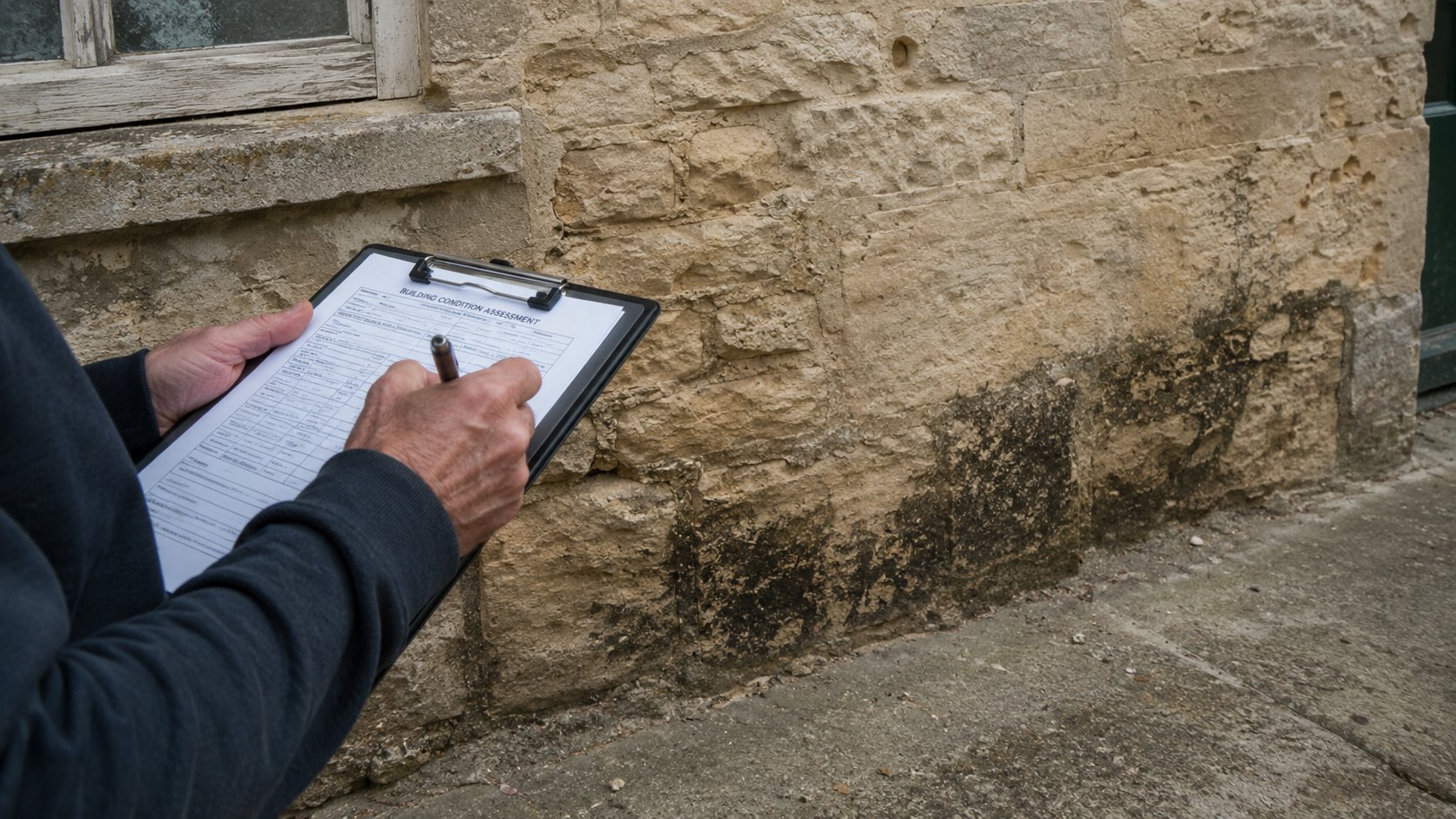

When viewing a property that needs renovation, buyers often ask: what should I actually be looking for? The answer depends on who is doing the looking. Most buyers see potential. A construction professional sees scope — and its cost.
What should I check on the outside of a renovation property?
The roof
Look at the ridge line — it should be straight. A sagging or uneven ridge suggests structural movement or failed timbers underneath. Check for missing or slipped tiles, dark patches indicating wet timber beneath, and the condition of any lead valleys, flashings, and chimney pointing.
Gutters and drainage
Blocked or broken gutters cause water to run down walls rather than away from the building. Look for green algae staining on external walls, overflow marks on brickwork, and the condition of downpipes. Follow them to the ground — blocked underground drainage is a common and expensive issue on older properties.
External walls and pointing
Look for cracks and note their pattern. Diagonal cracks at window and door corners suggest movement. Horizontal cracks in brickwork can indicate wall tie failure. Stepped cracks following mortar joints suggest differential settlement. Failed pointing on stone or brickwork is also a common cause of penetrating damp — repointing a whole property can cost £5,000–£12,000.
Windows and doors
Check how they open and close. Sticking or misaligned frames can indicate structural movement. Look at the base of timber window frames — rot at the cill is extremely common in older properties and often far more extensive than it appears from outside.
The limitation of a viewing: A viewing can only show you what is visible. Hidden defects — behind walls, under floors, in roof voids — can only be identified by someone who knows what to look for and has access to the whole building. That is what a proper pre-purchase assessment provides.
What should I check inside a renovation property?
The electrics
Look at the consumer unit (fuse box). Old-style fuse wire boards without RCD protection need replacing — see our guide to rewiring costs. Look for visible evidence of DIY electrical work: cables run along skirtings, mismatched socket and switch styles. These are signs of a system that has been patched rather than properly updated.
Damp and water staining
Look at the base of walls — especially on ground floors. Tide marks, bubbling paint, and plaster that sounds hollow when tapped all indicate moisture. See our guide to damp costs for what to expect. Any area of fresh plaster or new decoration in an otherwise unrenovated property warrants particular attention — it may be masking a known issue.
Ceilings
Brown or yellow staining indicates water ingress from above. Fresh or dark staining suggests an active problem. Any ceiling that moves or flexes needs investigation — lath and plaster ceilings in period properties can fail suddenly and expensively.
Floors
Walk every floor. Bounce or flex in timber floors indicates joist problems, rot, or inadequate support. Any floor covered with new laminate or fresh carpet in an otherwise unrenovated property is worth asking about.
Plumbing
Turn taps on and check water pressure. Ask about the boiler age and when it was last serviced — a boiler over 15 years old is approaching end of life and should be budgeted for replacement.
What questions should I ask at a renovation property viewing?
- When was the roof last replaced or significantly repaired?
- When were the electrics last updated — and is there an EICR?
- Is the property listed or in a conservation area?
- Has any structural work been carried out, and is there documentation?
- Is the drainage connected to mains or a septic tank?
- Have there been any insurance claims on the property?
Every renovation job, every range — and why the cheapest quote is usually the most expensive.
Turn what you saw into numbers.
NOROS Assessments translates a renovation property viewing into a realistic room-by-room cost breakdown — delivered within 48 hours of the site visit. From £250 for a full site visit assessment.
Get in Touch